I haven’t been putting up a blog post very often. Most of my online time has been on Facebook and now Google+.
My blog evolved into what I think of as my mini-magazine. Posting content from the news, pictures and videos. I can do that much more efficiently, and I think more effective on FB and Google+.
I would like to thank everyone who has contributed, through comments and linking to my site. I have had a great time, but until that 26 hour day comes along, I will be focusing on the other social media sites.
I have just started with Google+, and I while I still use Facebook more, Google+ is looking like very good, if they can build on the beta testing model. Hopefully I will be meeting many of you there.
The weatherman informs me we are in for a heat wave, which I don’t mind. It’s the humidity wave that kills me.
“Deep summer is when laziness finds respectability.”
Sam Keen
As I get older my summer activies have become more and more respectful.
Another quote I really like is by Desmond Morris:
“Life is like a very short visit to a toyshop between birth and death.”
Being an Atheist I believe we only get one shot at life. We should try to wring as much joy out of it as we can.
1) Here are two vidoes that I hope will lift your spirits and make you laugh
a) Members of the Great Whale Conservancy find a humpback whale near death – entangled in fishing gear in the Sea of Cortez. They cut the whale free from the net, an act requiring great courage on the part of rescuers and great trust on the part of the whale. The result is spectacular – the whale clearly thanks its human benefactors.
b) A kitten testing its hunting skills against the wild Apple monsters.
2) Too many, for far too long, the circumstances of their lives don’t bring them much joy.
“An internally displaced Somali family are seen outside their makeshift shelter at the Hiran IDP settlement in Galkayo, northwest of Somalia’s capital Mogadishu. Galkayo hosts over 60,000 internally displaced Somalis in 21 settlements and there are always new arrivals due to the prolonged drought.”
Photo by Thomas Mukoya/Reuters
American has had, and still has, its share of homeless refugees, as Woody Guthrie reminds us.
3) We all need the hope that our world can be better. For people living in desperate conditions that usually means someone reaching out a caring hand. Conditions don’t get more desperate than the killing fields of 1970 Cambodia.
Muoy You was one of the lucky ones who did survive that hell. Now she is reaching out her hand to try to help her countrymen.
From an article in the Christian Science Monitor series, People Making A Differnce” http://tinyurl.com/3ckpeon
Muoy grew up poor in Phnom Penh, Cambodia, during the Vietnam War. “We lived in a squatters’ shack, but I loved learning and I did well in school,” she recalls.
In 1972 she won a scholarship to study in France. It would save her from Pol Pot’s killing fields, where her parents and siblings were among the 2 million dead. She spent the next two decades in exile, raising a family and working as a teacher in Africa and the Middle East.
Now Muoy wants to transform the prospects of other Cambodian families by giving children of low-income cleaners, laborers, farmers, and tuk-tuk (motorized rickshaw) drivers a high-quality education.
“I don’t just want to teach them to read and write,” she stresses. “I want them to become professionals, writers, thinkers, artists – to make their country proud.”
In Cambodia today, few students have that chance; most have access only to basic education. So upon returning home to Phnom Penh in 2003, Muoy set up the Seametrey Children’s Village, a private initiative. She mortgaged a property she owned abroad, bought a small plot of land, and converted a run-down hut on it into a classroom.
“A school is just a building,” she notes. “It’s the resources that matter.”
Courteous and fluent in English, Muoy modestly calls herself “an obscure woman with dreams bigger than herself.” She started with a handful of young children – those of neighbors and acquaintances.
She ditched the rote learning that is common at crowded government schools and instead set about helping children discover the joys of learning by themselves in a free-spirited environment. “You shouldn’t just stick children behind desks,” Muoy explains. “You need to help them retain their childlike curiosity and spontaneity.”
“Parents pay according to their means. The poorest pay nothing; some pay small sums they can afford. Expatriates and better-off locals pay the full monthly fee of $290.
“A school like this would have been beyond our dreams,” says Ang Kim, a tuk-tuk driver whose two young daughters study in Seametrey. He can’t pay, but he volunteers as a security guard on Sundays.
Currently, the school has 80 students, from toddlers to teens. They learn in small groups from nursery through primary school. Whether from dirt-poor villages, urban slums, or well-heeled Phnom Penh homes, they’re treated alike – and are expected to treat one another alike, too.”
“Seametrey is a visionary project [aimed at] regenerating Cambodians’ self-respect and integrity,” says Elia Van Tuyl, a retired businessman in Palo Alto, Calif, who runs the Friends of Cambodia charity. “It seeks to attack poverty by addressing its psychological, educational, and cultural roots.
After just two years at Seametrey, young Samreth now speaks fluent English. “He’s a bright boy with leadership and oratory skills remarkable for his age,” Muoy says.
“I’m very happy for my grandchildren,” says Tes Kamsan, the boy’s grandmother. “They’ll have a much better life than their mother and I had.”
Muoy is certain of that. She points to a flowery vine in her garden. From its pot the plant has climbed all the way up to her fourth-floor balcony.
“That is my analogy for education,” she explains. “Place children in fertile soil, and they’ll blossom and flourish!”
“In Austria one of the strangest fights for religious freedom has come to an end: Niko Alm, a self-described “Pastafarian,” fought for three years for the right to wear a pasta strainer on his head in his driver’s license photo.
His argument? Alm claimed he belonged to the Church of the Flying Spaghetti Monster and wearing the strainer was part of his religion.
Niko Alm’s driver license (It is hard to see his “religious headgear”)
2) I have read about some pretty crazy alt med practices, but this may be the most insane.
A woman sits on railway tracks in Rawa Buaya, in Indonesia’s West Java province. The town’s residents believe that the electrical energy from the tracks will cure them of various illnesses.
Photo: Enny Nuraheni/Reuters
3) The humidity is slowing my pace to a crawl. Now I know how Tim Conway’s little old man feels.
The World’s Oldest Fireman (from the Carol Burnett Show)
4) World In Pictures
a. Art in Earth images from space, by NASA.
Grímsvötn volcano left behind a small lake filled with meltwater & a hole in Vatnajökull glacier. The lake covers much of the site of the eruption, with the possible exception of the crescent-shaped feature along the southern shore of the lake. This may be a tephra cone left behind by the eruption.
b. The two faces of Africa
The face of war – the refugee.
“Motril, Spain: A migrant wrapped in a blanket rests on a rescue ship after the fishing boat that he and 66 others were on was intercepted.” Potograph: Jon Nazca/Reuters
The hopeful future
So much of what we read of Africa involves civil and tribal warfare. This beautiful smiling face, a girl from Opuwo, Namiba, is I hope more representive of what Africa will become. Namibia has a stable multi-party parliamentary democracy. There is too much poverty, 50% by some estimates, but at least here hope may be replacing war.
Mother Nature is quite the prankster. A thunder storm knocked out our power when my clothes were in the washing machine, in our basement. I waited 7 hrs, until 9:00 pm. I finally had to take the wet clothes out and wring the water out each one by hand. I’ll have to re-rinse the clothes tomorrow to get the soap out. Just as I finished the power went back on. Ha ha, lol – @#%&%#@! Mother Nature.
“Ah, summer, what power you have to make us suffer and like it.” Russell Baker
1) World In Pictures
a.I would love to be a redneck for the day.
East Dublin, Georgia, USA: A participant in the Mud Pit Belly Flop contest jumps into the pond during the annual Summer Redneck Games. Photo: Richard Ellis/Getty Images
b.Looking at this old guys face my guess is his opinion of rock & roll is the same as my grandfathers.
Novi Sad, Serbia: A resident watches young people attending the Exit festival, one of south-eastern Europe’s largest rock and pop music events. Photo: Balazs Mohai/EPA
c.A dust storm with gusts of wind up to 60 miles per hour moves through Phoenix
d.An awesome view from a very dangerous place. War comes to Shangri-La.
Kunar province, Afghanistan: Spc Jacob Green, 22, with the US army’s 3rd Platoon, Charlie Company, 2nd Battalion 27th Infantry Regiment reads a book overlooking the Cherigal Valley at Observation Point Mustang
2) Giles Duley, war took three of his limbs, his can-do spirit stays alive.
“Mr. Duley heard a click and felt a flash of heat as the explosion lifted him into the air. He landed on his side on the dirt, roughly five yards from where he had stood. He smelled the stink of the explosives mixed with that of his own burned flesh. He took stock.
“I remember looking up and seeing bits of me and my clothes in the tree, which I knew wasn’t a good sign,” he said. “I saw my left arm. It was just obviously shredded to pieces, and smoldering. I couldn’t feel my legs, so straightaway and from what I could see in the tree, I figured they were gone.”
Mr. Duley had become, in that flash, a triple amputee. Now he risked swiftly bleeding to death. He recalled uttering a single word: “bollocks.”
“Mr. Duley, 39, was wounded in February in Kandahar Province, becoming another in the long line of casualties in the Pentagon’s offensive to displace the Taliban from one of its rural strongholds.
Five months on, after leaving the hospital, he is roughly midway through a 12-week physiotherapy regimen at Headley Court, a military rehabilitation center near London.
There, freshly fitted with two prosthetic legs and a left arm, he has been relearning to walk and confronting the details of pushing forward in life. Pulled along by what would seem an incurably upbeat mind, he is making plans to return to work as a photographer.”
“Since then he has been in almost continuous sessions of exercise and therapy, pushing himself upright and making himself start to walk, while accepting, he said, “that no matter how good I get, I will always keep falling.”
“For now, that means rounds of exercise alongside soldiers whose limbs were lost in the same ways. Gaining access to their regimen at the rehab center was difficult. Some in the government bureaucracy tried to block Mr. Duley’s admission.
Many objections were raised, including that as a civilian nearing 40, Mr. Duley was not in the same physical condition and mind-set as the young military men he would be working beside.
Three limbs gone, spirit whole, the photographer smiled as he recalled the exchange. “Don’t worry,” he said he jokingly assured the medical official who advanced that argument. “The soldiers will learn to keep up.”
3) Another great performance from the Rock & Roll Hall of Fame presentation.
Politicians worry about their poll numbers. We all worry about the numbers in our budgets. Today I go some great numbers from my doctor:
Blood Pressure 115/64
Cholesterol 190 LDL 110 HDL 70 (Until I went on my Diabetic diet my Cholesterol was in the 250 range)
Body Mass Index 21.6
Blood Sugar level 120
Fortunately none of the test involved how well my brain cells do, or don’t, function.
“The aging process has you firmly in its grasp if you never get the urge to throw a snowball.”
Doug Larson
1) The World In Pictures
a. The world of smiles and laughter
Havana, Cuba: Youths make a splash after a thunderstorm Photograph: Desmond Boylan/Reuters
b. The world of crying and tears.
Somali women displaced by severe drought conditions queue to get food handouts at a center operated by the government and local NGOs, south of Mogadishu, Somalia. Photo Feisal Omar/Reuters
c. The cement that binds communities together, moms and grand-moms and children.
Children watch as Sofia Alidad plays with her seven-month-old grandson, Asher Naeem, in front of her house in Rawalpindi, north-east Pakistan. Photograph: Muhammed Muheisen/ AP
2)Defining Beauty – Ms. Wheelchair America
Santina Muha
From an article in the Asbury Park Press, by Laura Martin:
“Defining Beauty: Ms.Wheelchair America,” is a documentary film about five disabled women. But Toms River resident Santina Muha, who is featured in the film, doesn’t want people to view her that way.
“Being in a wheelchair is a part of me, but it is not my defining characteristic,” says Muha, who represented New Jersey in the 2010 Ms. Wheelchair America pageant, which is the setting for “Defining Beauty.” “I am so many other things.”
“Yet Muha says many people only see her disability, which is the result of a spinal cord injury caused by a car accident when she was 5 years old.
She hopes the message of “Defining Beauty” changes that. The film, narrated by actress Katey Sagal, will be shown July 9 at the Long Island Film Expo and has previously been shown at the Staten Island Film Festival where it won “Best Documentary Feature” and at the Newport Beach Film Festival where it received the title of “Audience Award Winner Documentary.” Muha says the film is already affecting public perception of people in wheelchairs.”
“One man said during a screening that when he first started watching, he just saw five girls in wheelchairs, but by the end he saw each woman for who they were individually,” she says. “That is kind of the point of the film for me.”
I am not a fan a beauty contest, too much emphasis on the body, not enough on the brain. However I do look forward to the day when someone like Muha has the opportunity to compete in any beauty contest.
3) Music Videos
Tedeschi Trucks Band – Midnight In Harlem
Jeff Lorber and Eric Darius Live At Java Jazz Festival 2008
It must be hard to go back to work after a long holiday, although it is good to have a job to get back to. Of course I wouldn’t know. Being retired everyday is a holiday.
I celebrated the 4th of July at my cousin’s. Unfortunately the planned BBQ got rained out, it was too hot to cook inside so we had some traditional 4th of July Chinese take-out. General Tso chicken is almost as good as BBQ, almost. Had a great time.
Hope everyone had glorious 4th celebrating our nations birth.
1) John Mellancamp performs Our Country live with the Boston Pops Esplanade Orchestra at the Boston Pops Fireworks Spectacular July 4th 2007
2) Weekend Pics From the Net
a. World
Dadaab, Kenya: A Somali refugee waits in line with her daughter outside a food distribution point at a refugee camp. Photograph: Roberto Schmidt/AFP/Getty Images
Queen of Cats by Franko
b. Children
Young boy enjoying water spray at Glastonbury Festival, UK
Dolly” photo by Oleg Ilyian
3) Australian comics John Clark and Bryan Dawe explain the European debt crisis. We can subsitute any debt crisis, government, state, or city, and the same logic applies.
4) Another John Mellancamp classic performance of one of the best songs about the real, working class, America, Little Pink Houses.
It has been an incredible, beautiful, day. What a great start to a holiday weekend celebrating the birth of our country.
I will be at my cousin’s BBQ, I love the taste of burnt meat.
Speaking of burnt/fired food we don’t have to look at the wording on the sign to know what country this county fair is being held, and I want one of everything.
People at the San Diego county fair visit food stalls selling a certain type of American cuisine: deep fried butter, chocolate-covered corn dogs and chocolate-covered bacon. (Photograph: Mike Blake/Reuters )
Man, I would love to join these kids playing with giant giant bubbles as the sun sets at Moonlight Beach in Encinitas, Calif. (Photo Mike Blake/Reuters)
Everyone have a great weekend. I’ll leave you with some good old American country music.
1) Tony Campolo, of the Red Letter Christians Blog, writes of truisms we should live by. I am an Atheist not a Christian but I belive they apply to everyone on the planet http://tinyurl.com/3c2hq7u
1.You have no control over what you get; only over what you give.
2.You have no control over how long you live; you only have control over how well you live.
3.Play the hand that you are dealt. If you look at it closely, it’s a better hand than you think you were dealt.
4.It’s never too late to have a happy childhood. In other words, it’s never too late to become what you might have been.
4.“It’s not what you do that makes you great,” said Henri Nouwen, “it’s how you do it.”
5.Mother Teresa said, “We can’t all do great things, be we all can do small things with great love.
2) The “It Gets Better” project was started by syndicated columnist and author Dan Savage, http://tinyurl.com/2dvusvc
“Growing up isn’t easy. Many young people face daily tormenting and bullying, leading them to feel like they have nowhere to turn. This is especially true for LGBT kids and teens, who often hide their sexuality for fear of bullying. Without other openly gay adults and mentors in their lives, they can’t imagine what their future may hold. In many instances, gay and lesbian adolescents are taunted — even tortured — simply for being themselves.
Justin Aaberg. Billy Lucas. Cody Barker. Asher Brown. Seth Walsh. Raymond Chase. Tyler Clementi. They were tragic examples of youth who could not believe that it does actually get better.
While many of these teens couldn’t see a positive future for themselves, we can. The It Gets Better Project was created to show young LGBT people the levels of happiness, potential, and positivity their lives will reach – if they can just get through their teen years. The It Gets Better Project wants to remind teenagers in the LGBT community that they are not alone — and it WILL get better.”
This video by 13 US Senators shows some of our politicians are supporting this project of acceptance, and equality.
3) World In Pictures
a. In Jordan women get all the good jobs.
“A Jordanian female deminer uses a detector to clear a minefield in the northern Jordanian- Syrian border area, near Ramtha city.” (Nader Daoud/AP)
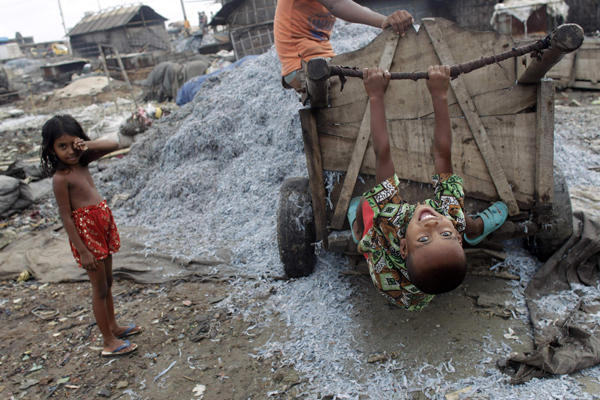
b. A picture of children playing should make us laugh. This one makes me cry.
Children play on waste products at a tannery, Dhake, Bangladesh (Andrew Barij/Rueters)
Rather then try to explain what a beautiful day it is I’ll let James Russell Lowell do it.
From The Vision of Sir Launfal :
“And what is so rare as a day in June?
Then, if ever, come perfect days;
Then Heaven tries the earth if it be in tune,
And over it softly her warm ear lays:
Whether we look, or whether we listen,
We hear life murmur, or see it glisten;
Every clod feels a stir of might,
An instinct within it that reaches and towers,
And, groping blindly above it for light,
Climbs to a soul in grass and flowers”
1) Joy
We will find no better picture of joy than on the faces of those whose loved ones have been saved.
Libyans wave to their relatives as a ship docks in the rebel-held port of Juliana, in Benghazi. The trip was organized by the International Committee of the Red Cross (ICRC) to evacuate some 300 people from Tripoli to Benghazi. (Mohamed Abd El-Ghany /Reuters)
2) Despair
The sound of silence that can be found in every heart that has yet to find a source of faith that can help them believe tomorrow can be better.
3) Hope
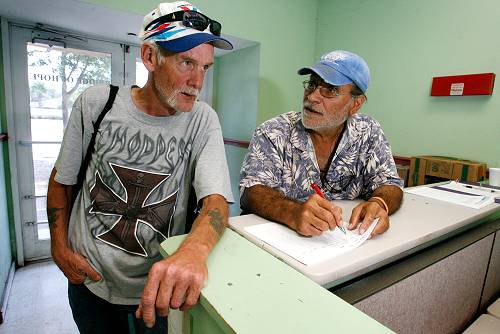
Two homeless men, Brad Carter and Norman Gignacir, have formed the HOME of Daytona Beach to aid others on the street.
Jon Pichardo, right, checks in Norman Gignac for the midday meal Friday at the Volusia-Flagler Coalition for the Homeless in Daytona Beach. (N-J | Nigel Cook)
“Brad Carter can hardly remember the last time he got more than two hours of sleep at night.
The homeless man doesn’t feel safe disappearing into remote thickets of woods, and the public places he chooses usually draw too much attention to his snoozing. Not long after the 44-year-old closes his eyes, someone is usually shaking him and telling him to go somewhere else.
So he wanders, and sometimes he plunges into such exhaustion he falls asleep walking.
“Try sleeping with your door wide open and see how safe you feel,” said Carter, who’s been homeless for four years. “That’s what it’s like sleeping on the streets.”
A year ago, Carter reached his saturation point with never having a spot to slow down, never having a roof over his head, never being given a chance to prove himself on a job.
So he and a homeless friend, 60-year-old Jon Pichardo, started a group they hope will not only help them, but also hundreds of others on Daytona Beach’s streets struggling to return to a reliable paycheck and a place with four walls and a roof they can call their own.
They launched HOME of Daytona Beach, a nonprofit agency that’s helping with jobs, shelter and permanent housing, and also working toward improving the perception of the homeless.”
“To work toward changing stereotypes, some of the group members volunteer at the homeless coalition, Halifax Urban Ministries and other social service agencies. They’re also trying to organize a one-day art and music festival this summer that would showcase the talents of local homeless people.
“We feel the only way that conditions are going to change for the homeless is to change public perception of the homeless,” Carter said.
The conditions they want to change are pretty basic. They’d like to see another homeless shelter in the city with about 150 beds. ”
“Inspired by his own experiences living with muscular dystrophy, Griffin began imagining how wheelchairs and walkers could be improved. The company’s prototypes for a wheelchair that provides easier access to a rider’s backpack, and an adjustable walker, are now being finalized.
How did you come up with these assistive technology devices?
Griffin Latulippe: Along with four other high school students in the Junior Engineer Technical Society. I entered into the National Design Challenge. Our goal was to create a device to help disabled people in the workplace. We came up with the wheelchair first. It has an arm that swings around so you can easily grab things from the backpack most wheelchair users have to carry their things. Our interest in disabled people’s needs grew, and in the second year, we created a walker for going up and down stairs, with front legs that expand and retract.
What kind of distribution are you envisioning?
We will sell as many products as there’s need. If that means globally, we’d love that. The goal is not necessarily to make money. The goal is to help people.
3) Dominic Deng Diing, who escaped the violence in Sudan, raises funds to help schoolchildren there.
“Dominic Deng Diing’s first teachers were his uncles, who sang the ABCs to the then 6-year-old as they undertook the painstaking walk from Sudan to Ethiopia in the mid-1980s.
Mr. Diing’s brief foray into education was cut short when his uncles and brothers died of starvation during the trek, along with thousands of other “Lost Boys of Sudan” children who fled on foot from the civil war that raged for nearly 20 years.
But the significance of the early lessons stuck with Diing, now a resettled refugee living in Buffalo, NY. He earned his high school degree in Kakuma, a refugee camp in Kenya, and later completed undergraduate and master’s programs in western New York. He’s currently working toward a doctorate degree in education.”
“Diing is trying to spare more than 3,000 children in South Sudan from his experience. They now attend the two-year-old New Hope Primary School, a project of Diing’s Buffalo-based nonprofit group Aid and Care for Africa.”
“Some 55 percent of the students are orphans, living with foster families. They include 10 of the 34 children Diing sponsors himself and his mother looks after. The remaining 24 live with two of his sisters in Kenya and Uganda, where they can receive care for various ailments.
In total, Diing supports about 50 people aside from his mother, including his deceased father’s seven other wives.
“I live a simple life here,” says Diing, speaking at a buffet restaurant near his tiny apartment just north of Buffalo’s downtown. “But it’s the same as my friends do – the little amount we make, we share.”
4) Some more Natalie Merchant “San Andreas Fault”, from a 1999 concert in New York City. I own a DVD of the concert, that I highly recommend.






 The World Through My Eyes
Recent Comments